
Disclosure: Millennial Potash Corp. has paid FRC a fee for research coverage and distribution of reports. See last page for other important disclosures, rating, and risk definitions.
The analyst’s rating and fair value are one click away. Free FRC account, no credit card.
Already have an account?
The current estimate covers only 1.5% of the project area. We believe there is potential for resource expansion as the deposit remains open in multiple directions. MLP is aiming to complete a Preliminary Economic Assessment (PEA) in the coming months.
Africa imports most of its potash consumption from Russia. In addition to Africa, a major target market for Banio’s potash is Brazil, which imports 95% of its potash demand from Canada, Russia, and Belarus. Gabon’s proximity to Brazil implies that MLP should have lower transportation costs than other potash suppliers.
Potash prices are down 45% YoY. Fertilizer demand declined last year, influenced by sluggish global GDP growth, elevated interest rates, and volatile fertilizer prices. On a positive note, fertilizer prices have begun stabilizing, which we believe should encourage increased consumption among farmers. We are cautiously optimistic, and anticipate a recovery in demand this year. As Russia and Belarus account for approximately 35% of global potash supply, we believe the potash market has a highly vulnerable supply chain.
Management and board own 30% of MLP’s equity. Management has a highly successful track record in resource exploration and M&A. Their previous deals included – a) Millennial Lithium – sold to Lithium Americas (NYSE: LAC) for $490M in 2022, b) Allana Potash - sold to Israel Chemicals (NYSE: ICL) for $170M in 2015, and c) Potash One – sold to K&S (DE: SDF) for $430M in 2011.
Upcoming catalysts include the upcoming PEA, and resource expansion drilling. 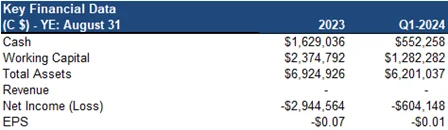
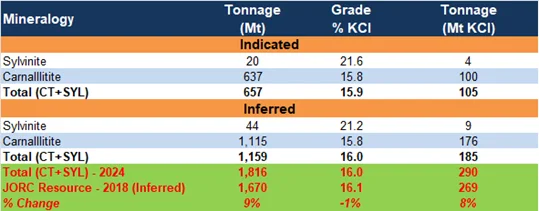
Maiden Resource for the Banio Potash Project, Gabon
Location Map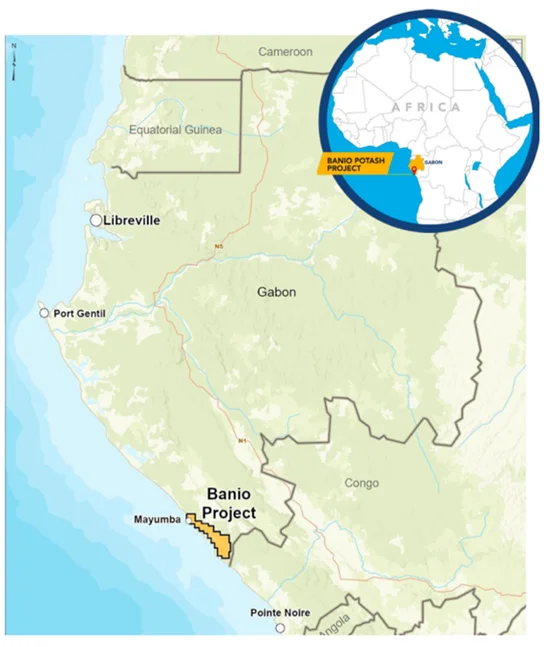 Source: Company
Hosts a large-tonnage/low-grade potash deposit
Located in the potash-rich Congo Evaporite basin in Gabon, which hosts several large potash deposits
Gabon’s oil and gas sector hosts majors such as Fortescue (ASX: FMG), Eramet (ENXTPA: ERA), Total (NYSE:TTE), and Shell (NYSE: SHEL)
Gabon, known for its vast petroleum reserves, ranks third in terms of GDP per capita among African nations. It was a relatively stable country in Africa until last year, when a military coup ensued, leading to the removal of the President, whose family had held onto power for 50+ years. While there have been no reports of unrest within or in close proximity to the Banio project area, the coup has sparked concerns about the country's economic stability and security. On a positive note, in a recent meeting between MLP’s Chairman and the new President of Gabon, the President expressed his full support for MLP, while emphasizing the importance of attracting foreign investments.
Banio Resource Estimate
 Source: Company/FRC
The latest resource estimate, which was based on two holes/2,260+ m of drilling, has expanded and confirmed the previous estimate
Total contained KCl is up 8%, with no material change in grades
The deposit is dominated by low-grade carnallite mineralization
Resource Envelope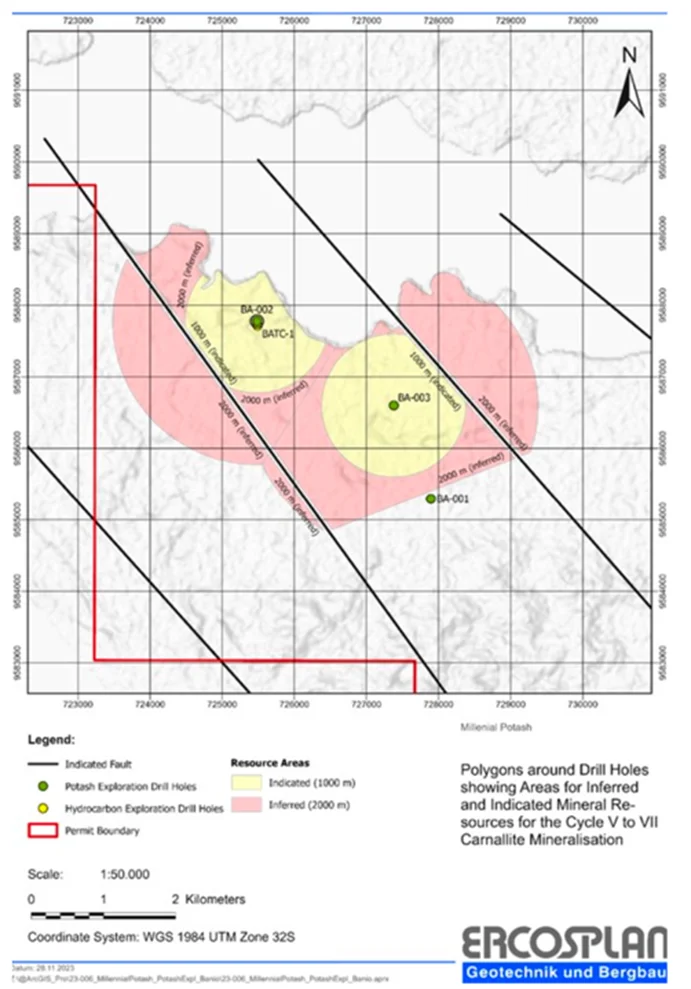 Source: Company
The resource envelope measures 5 km (length) x 3 km (width) x 0.2 km (thickness)
Mineralization has been identified at depths ranging between 230 m and 520 m below surface; we note that Banio’s potash beds are shallow compared to projects in Saskatechwan (800-1,500 m deep)
We believe there is potential for resource expansion as the deposit remains open in multiple directions
The maiden resource accounts for only 1.5% of the project area
Potash beds of Banio are amenable to solution mining, wherein heated water/brine is injected through wells to dissolve ore, and pumped back to surface
Typical Solution Mining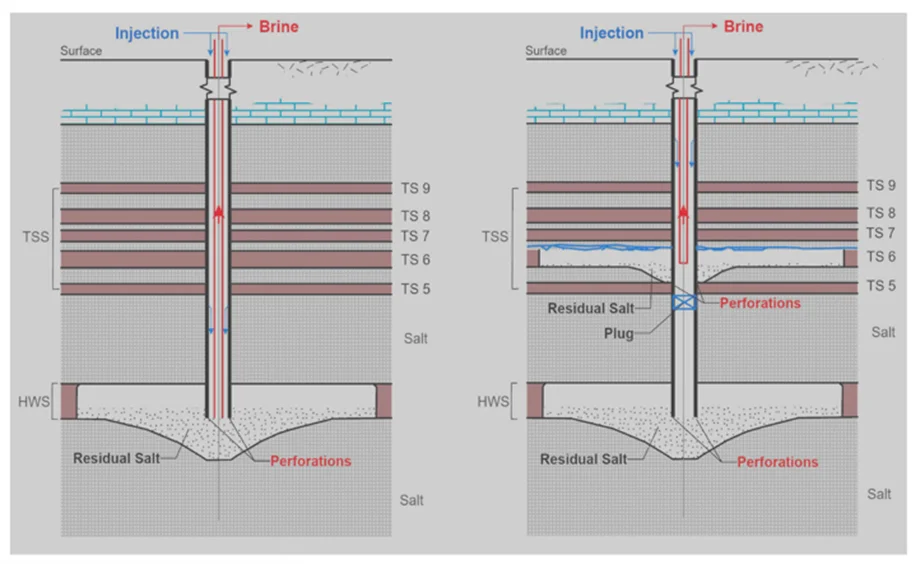
Source: Company
The deposit is open-pittable, implying potential for relatively low OPEX/CAPEX
Solution mining has lower CAPEX than conventional underground mining
A direct comparable to Banio is the Kanga project, located 60 km to the south, in the Republic of Congo. This project has carnallite resources as well, totaling 12 Bt grading 16.9% KCl (depths ranging between 300 m and 1,100 m). As these grades and depths are very similar to that of Banio, we believe Banio should generate similar economics as Kanga.
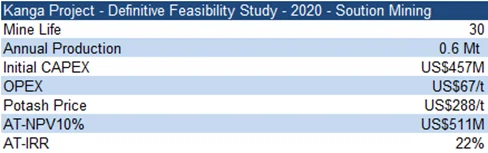
Source: FRC/Kanga
A DFS, based on a small-scale production scenario (0.6 Mt/year using solution mining), returned an AT-NPV10% of US$511M
This project has an unusually low OPEX (US$66/t), due to its shallow and thick resources
Upcoming Plans
Management’s Target Timelines
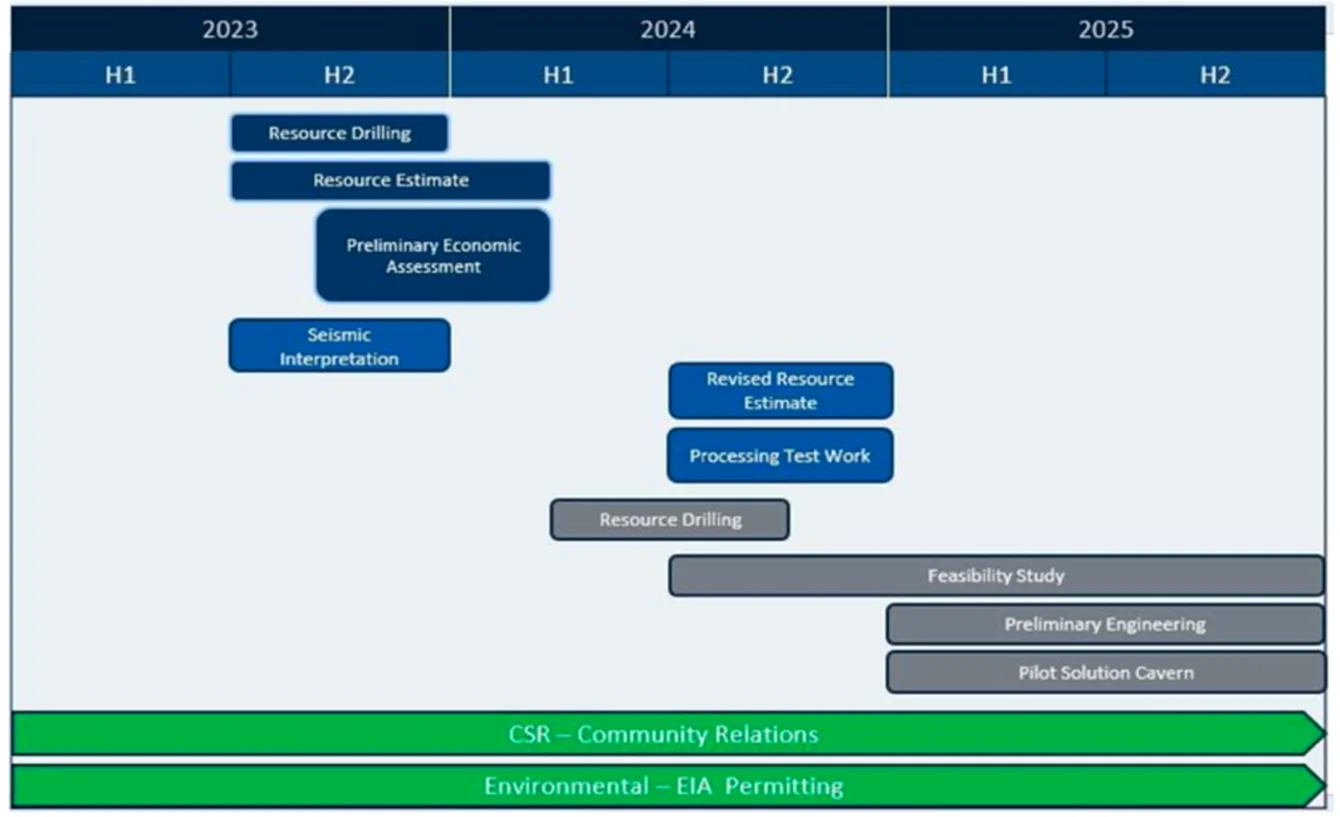
Source: Company
Management is planning resource expansion drilling, and aiming to complete a PEA in the coming months
Financials
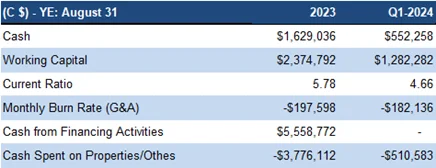
In December 2023, MLP raised $1.1M through an equity financing
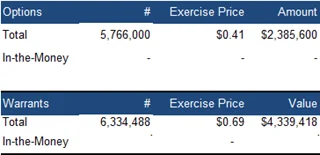
FRC Valuation
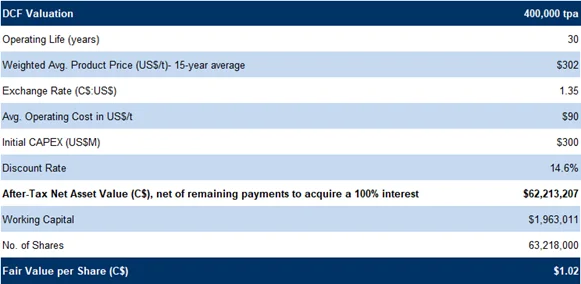
Our DCF valuation decreased from $1.25 to $1.02/share
Valuation declined due to share dilution since our previous report, and as we raised our discount rate estimate from 13.6% to 14.6% to account for elevated country-risk levels; we typically use 11.6% for development-stage projects in North America
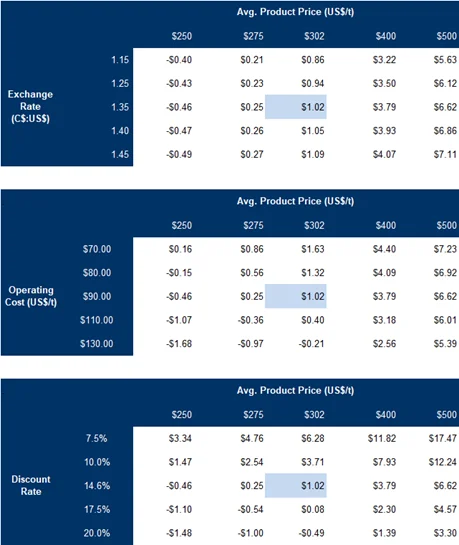
Our valuation is highly sensitive to key inputs
We are reiterating our BUY rating, and lowering our fair value estimate from $1.25 to $1.02/share. As fertilizer prices have started stabilizing, we anticipate a recovery in potash demand in 2024. Key catalysts for the stock include the upcoming PEA, and resource expansion drilling.
Risks
We believe the company is subject to the following key risks:
- The value of the company is dependent on potash prices
- Exploration and development
- FOREX
- Access to capital and potential for share dilution
- No economic studies