
Disclosure: Loncor Gold Inc. has paid FRC a fee for research coverage and distribution of reports. See last page for other important disclosures, rating, and risk definitions.
The analyst’s rating and fair value are one click away. Free FRC account, no credit card.
Already have an account?
A 2021 Preliminary Economic Assessment (PEA) returned an AT-NPV5% of $600M, and an attractive AT-IRR of 25%, using $1,600/oz gold. LN is trading at just 6% of the AT-NPV. AT-NPV increases to $1B at $1,840/oz gold (gold is currently at $2,047/oz). Adumbi has potential to produce 300+ Koz ever year, making it a mid-sized gold mine.
LN is set to drill beneath the open-pit shell, aiming to outline additional resources totaling 1.5 Moz at 4.8 gpt.
Resolute Mining Limited/ASX: RSG (21%), Newmont/NYSE: NEM (5%), and LN’s Executive Chairman (20%) own 46% of LN’s equity.
We maintain a positive outlook on gold in light of the proposed rate cuts by the Fed, and as we anticipate inflation will remain above its historic average in 2024.
M&A activities in the junior gold sector are on the rise. Recent transactions in the African gold sector involved Dundee Precious Metals’s (TSX:DPM) acquisition of Osino Resources (TSXV: OSI/gold in Namibia) for $215M, Silvercorp Metals’s (TSX: SVM) acquisition of Orecorp (ASX: ORR/gold in Tanzania) for $186M, Fortuna Silver Mines’s (TSX: FVI) acquisition of Chesser Resources (ASX: CHZ/gold in Senegal) for $60M, and Zhaojin Mining’s (SEHK: 1818) acquisition of Tietto Minerals (ASX: TIE/a brand new gold producer in Côte d’Ivoire) for $422M. We estimate an average price of C$82/oz for these deals. We believe Loncor is an attractive M&A target, given that its shares are trading at just C$19/oz.
Loncor has been exploring the DRC since 2009. Its portfolio includes the advanced- stage Imbo project, and the pre-resource stage North Kivu project.
Company Overview
Portfolio Summary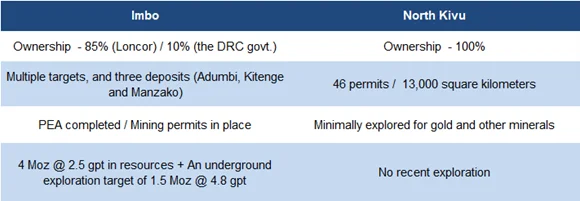
Source: Company
Entered into an agreement to seel a non-core asset, located near lmbo, for C$13.5M
Mining in the Democratic Republic of the Congo
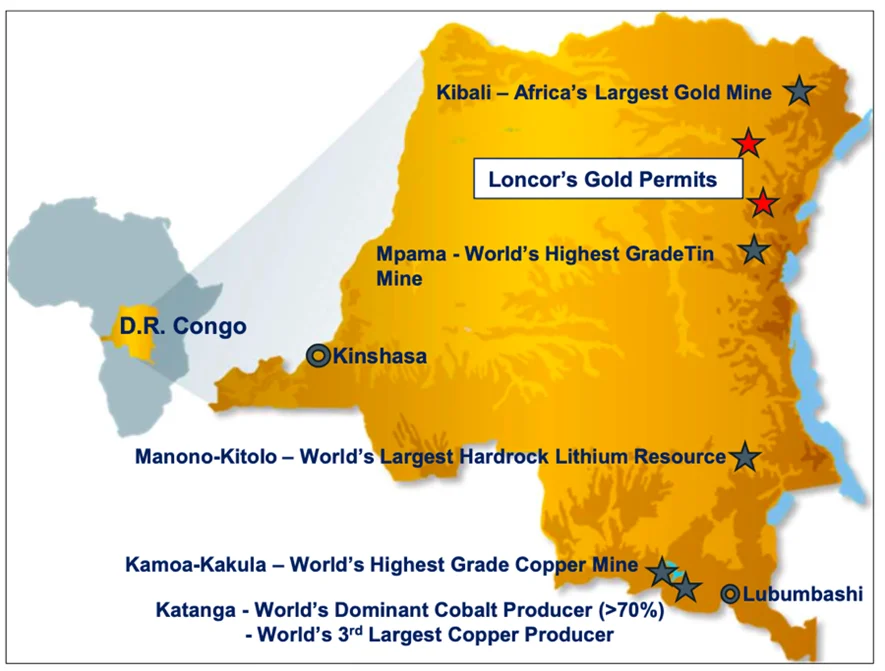
The DRC is the sixth largets gold producer in Africa, the fourth largest copper producer in the world, and the largest cobalt producer in the world.
Loncor's Focus
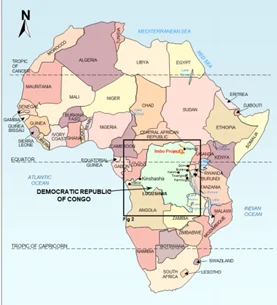
Source: Technical Report
The DRC is the sixth largest gold producer in Africa
According to the Fraser Institute Survey of Mining Companies, the DRC is ranked low in terms of investment attractiveness for mining. This ranking takes into account multiple factors such as environmental regulations, regulatory duplication, and political stability. We believe lack of transparency and security concerns have been deterrents for investors.
Despite the negative sentiment, over the last decade, there has been notable growth in the production of various minerals in the DRC. Several majors, several majors, such as Barrick, AngloGold Ashanti (NYSE: AU), Glencore (LSE: GLEN), Ivanhoe Mines (TSX: IVN), Zijin Mining (SEHK: 2899), and China Molybdenum (SEHK:3993), operate in the country due to its huge reserves of cobalt, copper, and gold.
LN is 220 km from one of the largest gold mines in Africa
LN’s Imbo project in the Ngayu gold belt is approximately 220 km from Barrick’s Kibali gold mine – the largest gold mine in Africa. In 2022, this mine produced 750 Koz of gold, with low cash costs of $703/oz (AISC – $948/oz). It hosts open-pit and underground resources totaling 8.2 Moz gold at 3.1 gpt. This is comparable to LN’s Adumbi project, which hosts an open-pit resource of 3.7 Moz at 2.4 gpt.
Kibali is 220 km from the Ngayu belt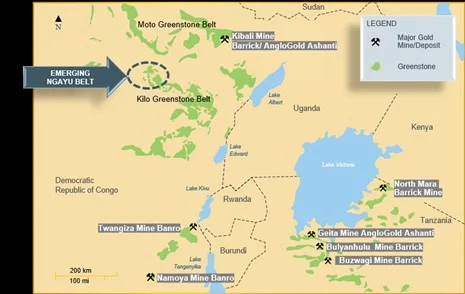
Source: Company
The open-pit resource at Adumbi is comparable to that of Kibali
Overview of the Ngayu Belt
The Ngayu Archean Greenstone Belt of northeastern DRC has been sporadically explored since the early 1900s. The belt is geologically similar to the belts which host the Kibali mine, and AngloGold Ashanti’s Geita mine in Tanzania.
Similar to Kibali and Geita, gold mineralization at Ngayu is related to Banded Ironstone Formation (“BIF”). BIF gold deposits tend to be large tonnage. Other well known BIF deposits include Tasiast (Mauritania), Homestake (U.S.), and Morro Velho (Brazil). Although the Ngayu belt is three to four times the size of the Geita belt, it is relatively under explored.
Imbo Project
Ownership and Location
In 2019, LN acquired control of the Imbo project from Resolute, and its partner. LN owns 84.68%, minority shareholders own 5.32%, and the DRC government owns the remaining 10%. LN is responsible for 100% of exploration/development costs until a bankable feasibility study.
Location of the lmbo Project
Source: Company
Mining permits in place
The nearest city, Beni, is 230km by air southeast of the property, and 375km by road (mostly gravel roads)
Natural water sources are abundant in the region. The closest hydroelectric power stations, situated 220 km away, supply power to the Kibali mine. Should Adumbi advance to production, management envisions hydro power as a viable source, which is a significant factor contributing to Kibali's low cash costs.
History of the Imbo Area
The project has been subject to small scale mining between 1925 and 1955. 291 Koz was produced from Adumbi. 234 holes totaling 46,076 m were drilled between 2010 and 2017.
The lmbo Project Area in the Ngayu Belt
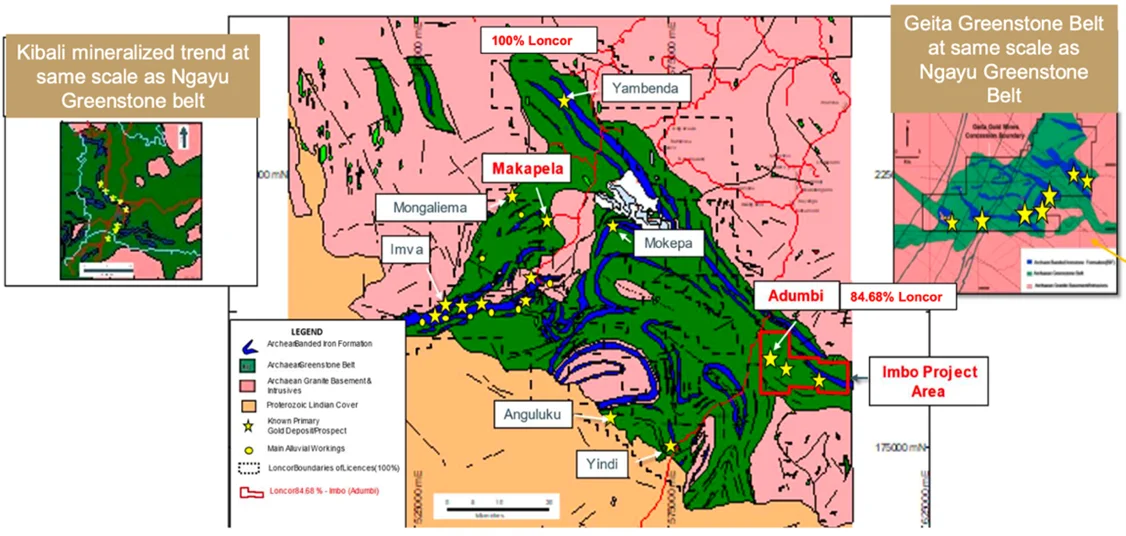
A 14 km long mineralized trend hosts several targets, with potential to host a mining district
The project contains several targets, of which three have NI 43-101 compliant resource estimates (primarily open-pittable)
Target Deposits within lmbo, East of the Ngayu Belt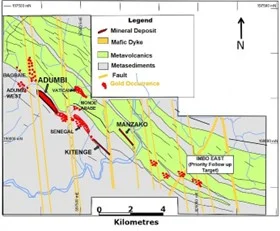
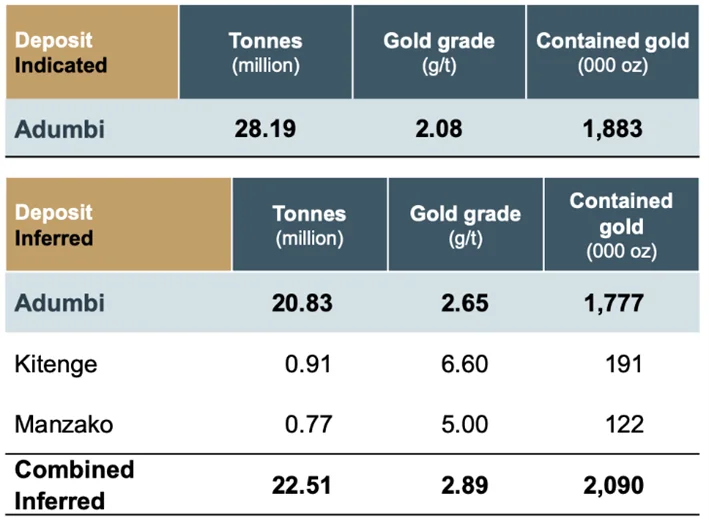
Most of lmbo's resource comes from Adumbi and the rest from Kitenge, Manzajko
These three deposits are 5 km from each other, and can likely be part of the mine plan
Resource for the lmbo Project (2021)
Source: Company
The Adumbi deposit has been drilled along 900 m strike, and 650 m downdip
A relatively high-grade/large open-pit resource
2021 PEA of Adumbi
Conceptual Pit Outline
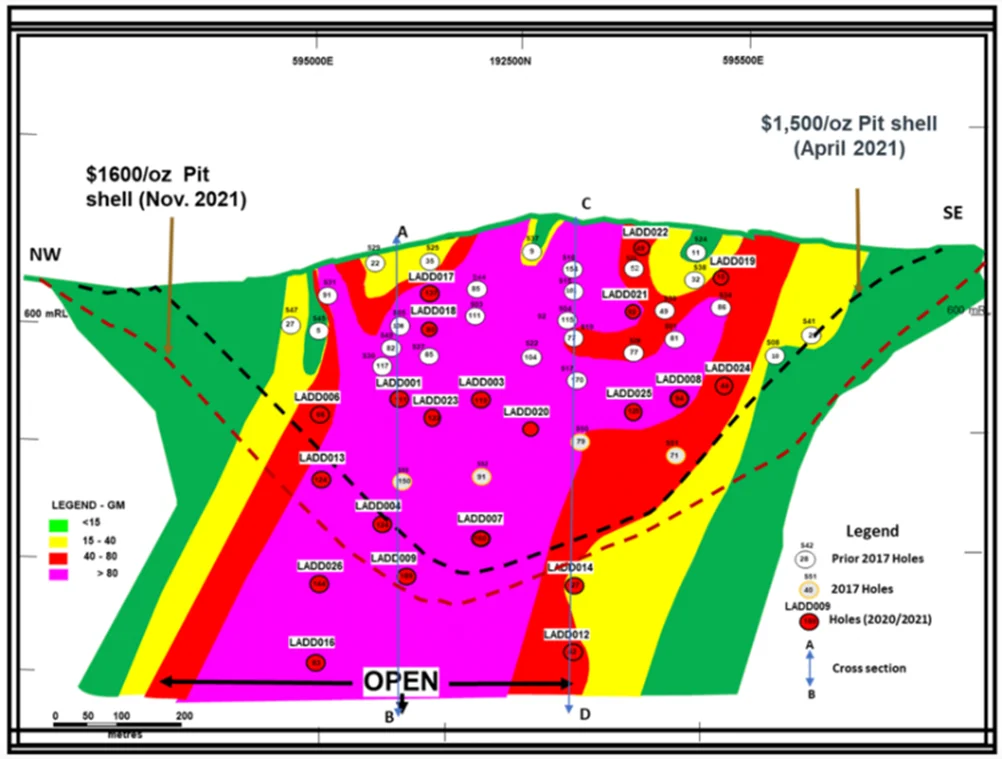
85% of its resource is within fresh rock (sulphides); metallurgical tests indicate a high recovery rate (90%)
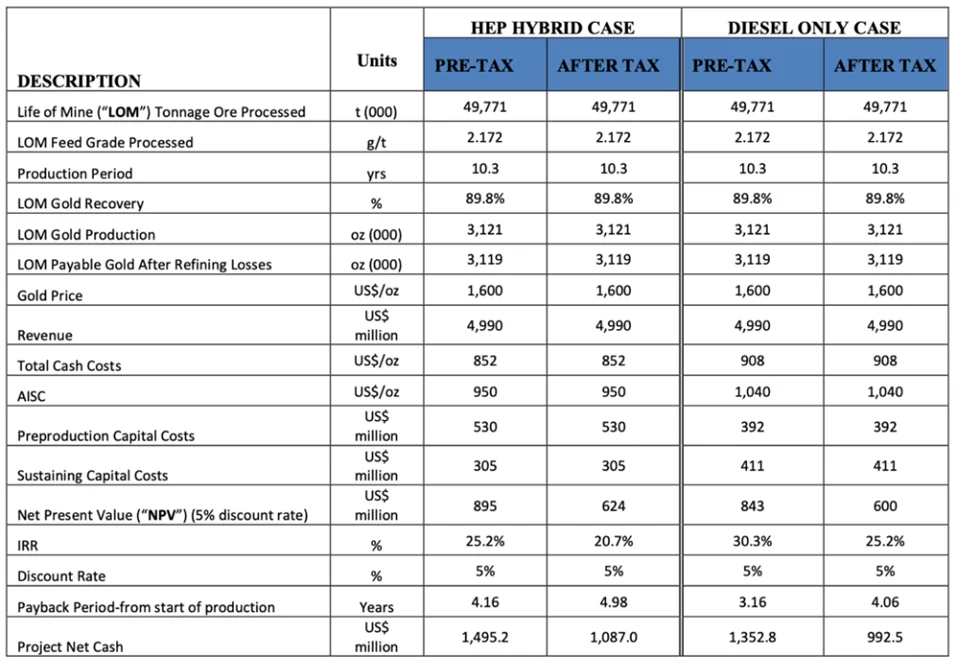
A PEA completed in 2021 returned an AT-NPV5% of $600M, and a high AT-IRR of 25%, using $1,600/oz gold
Annual production of 303 Koz, making it a mid-sized gold producer
2021 PEA Highlights
Source: Company
Reasonable inital CAPEX of $392M, and cash costs of $908/oz
AT-NPV5% increases to $1B at $1,840/oz gold
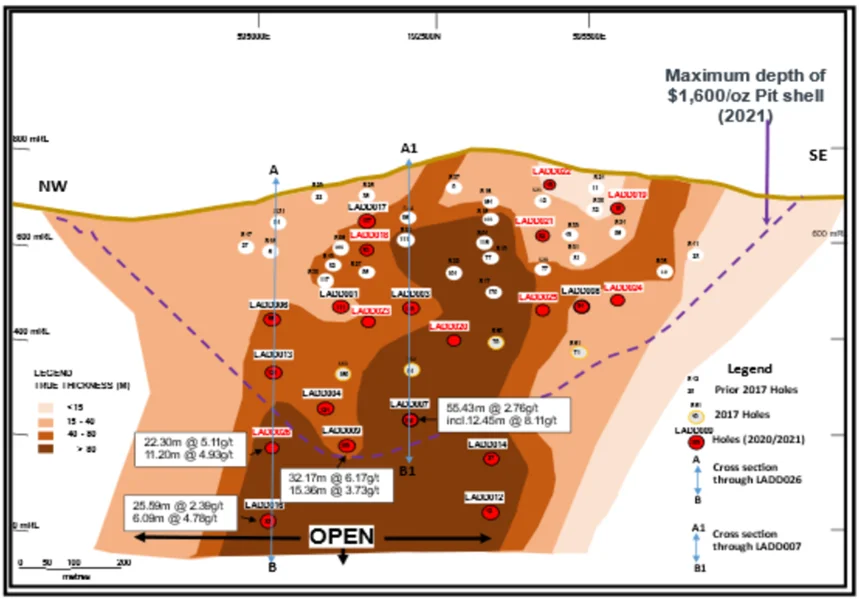
LN intends to drill below the open-pit shell to potentially delineate underground resources. Management has assigned an exploration target of 1.5 Moz (4.8 gpt) below the Adumbi pit-shell.
Adumbi Resource Upside
Source: Company
Adumbi is open at depth with significant resource expansion potential at a depth of 800m below surface
Management is targeting a 5M+ oz resource for the project. For conservatism, our valuation is based solely on the existing resource. With the recent cash infusion from the Makapela sale, management is exploring various avenues including drilling deeper below Adumbi, regional drilling at the Imbo East area located 10 km from Adumbi, and/or infill drilling to enhance resource certainty at Adumbi.
Financials
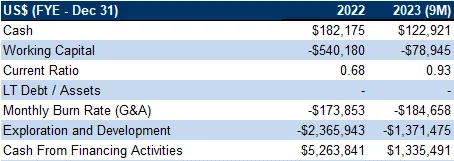
Given the sale of Makapela, LN will not have to raise any capital in the near-term
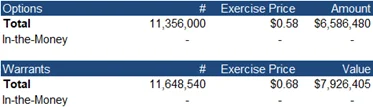
None of the outstanding options/warrants are in-the-money
Source: FRC./S&P Capital IQ/Various
Comaparbles Valuation
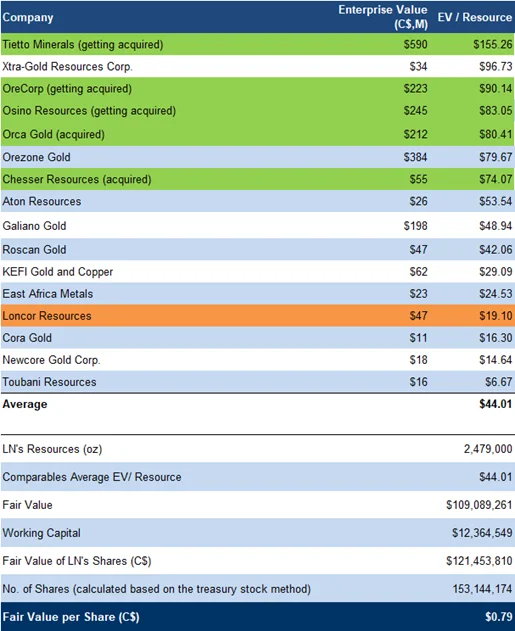
African gold juniors are trading at C$44/oz, based on 100% of M&I + 50% of inferred resources
LN is trading at C$19/oz, reflecting a 57% discount
Recent acquisitions, highlighted in green, were prices at an average of C$82/oz
Applying the sector average EV/oz of C$44.oz to LN's resources, we arrived at a comparables valuation of C$0.79/share
FRC Valuation and Rating
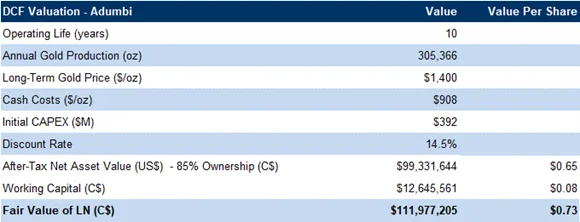
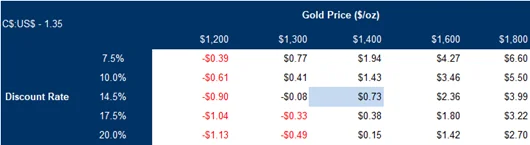
Our DCF valuation is C$0.73/share
Source: FRC
We are using a higher dicsount rate of 14.5% to account for country risk premium; we typically use 11.5% for golf projects in North America
We are resuming coverage with a BUY rating, and a fair value estimate of C$0.76 per share (the average of our DCF and comparables valuations). We believe LN is an excellent acquisition target due to its attractive valuation metrics, high-grade resources, robust PEA, and potential for resource expansion.
Risks
We believe the company is exposed to the following key risks:
Ø The value of the company is dependent on gold prices
Ø Geopolitical risks
Ø Exploration success
Ø FOREX