

Disclosure: Homerun Resources Inc. has paid FRC a fee for research coverage and distribution of reports. See last page for other important disclosures, rating, and risk definitions.
The analyst’s rating and fair value are one click away. Free FRC account, no credit card.
Already have an account?
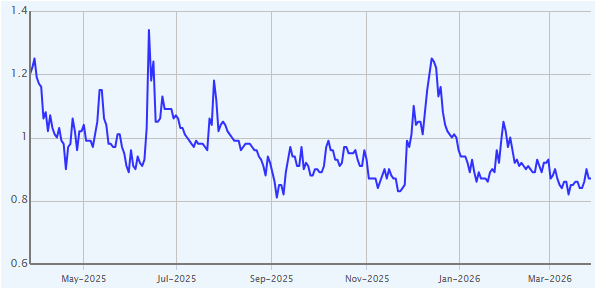
Price and Volume (1-year)
*Qualified Person: Dr. Roque Yuri Tandel, Ph.D., Geologist and Partner at Geoinform. Homerun Resources Inc. has paid FRC a fee for research coverage and distribution of reports. See last page for other important disclosures, rating, and risk definitions. All figures in C$ unless otherwise specified.
High-purity quartz (HPQ) is ultra-refined with SiO₂ concentrations above 99.997%, and minimal impurities, essential for high-tech applications like semiconductors, and solar panels
Market Overview
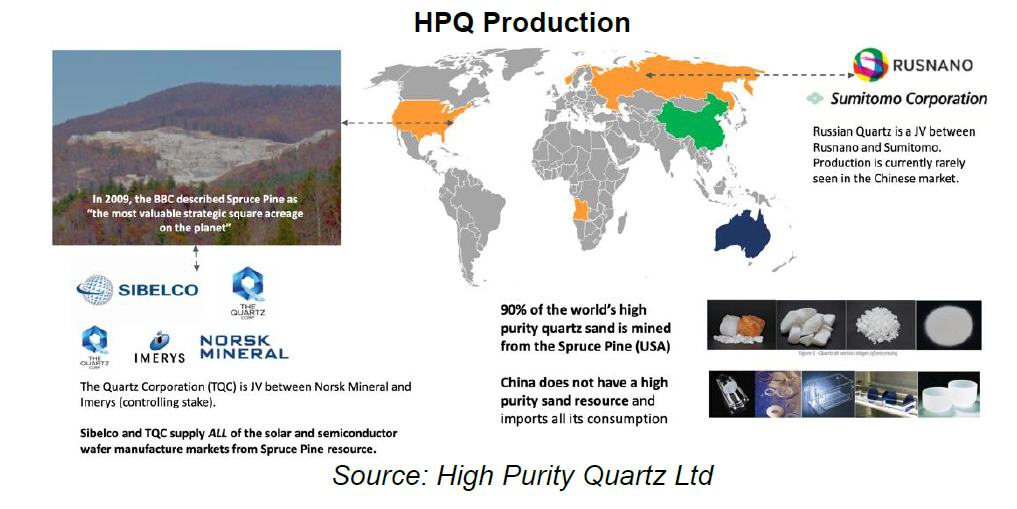
The U.S., Canada, and EU classify silicon as a critical mineral
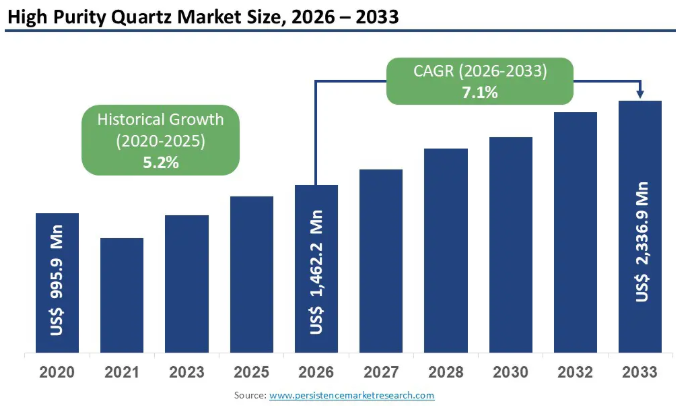
It is estimated that the global HPQ market will grow 7% p.a., from US$1.4B in 2026, to US$2.3B by 2033, driven by semiconductor and solar energy demand
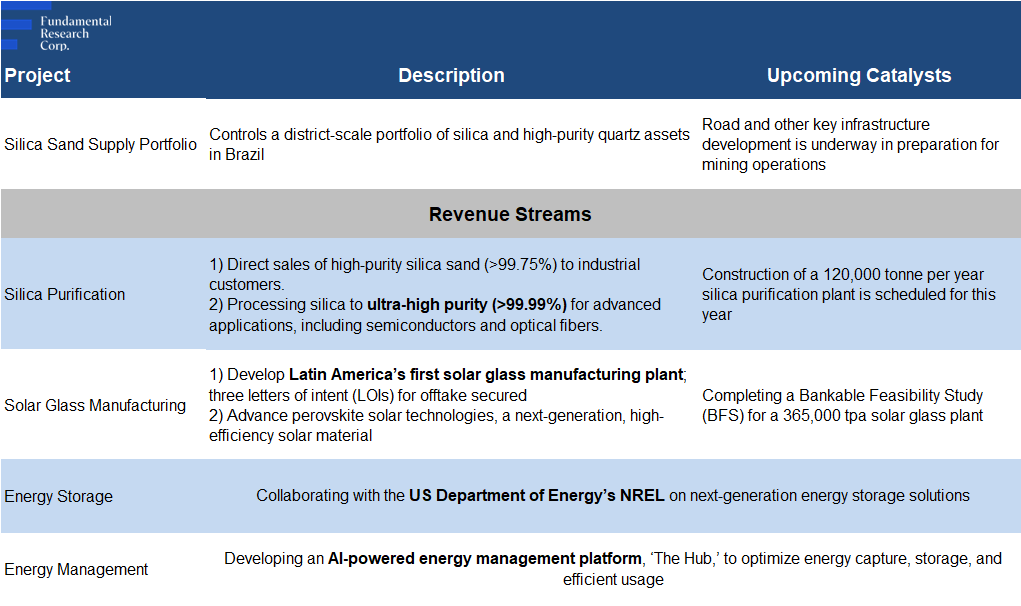
Four Verticals: From Mine to Market
HMR operates across four verticals, covering the entire value chain from mine to market.
Primary Business Units
Source: Company / FRC
HMR aims to build a fully integrated HPQ industrial vertical, covering the entire value chain from raw material extraction, to the production of solar and energy storage products
HMR is receiving government support, including land, and incentives, to build its solar and silica facilities
Silica Sand Supply Portfolio - Belmonte Silica District, Brazil
Silica Sand Supply Portfolio
Source: Company
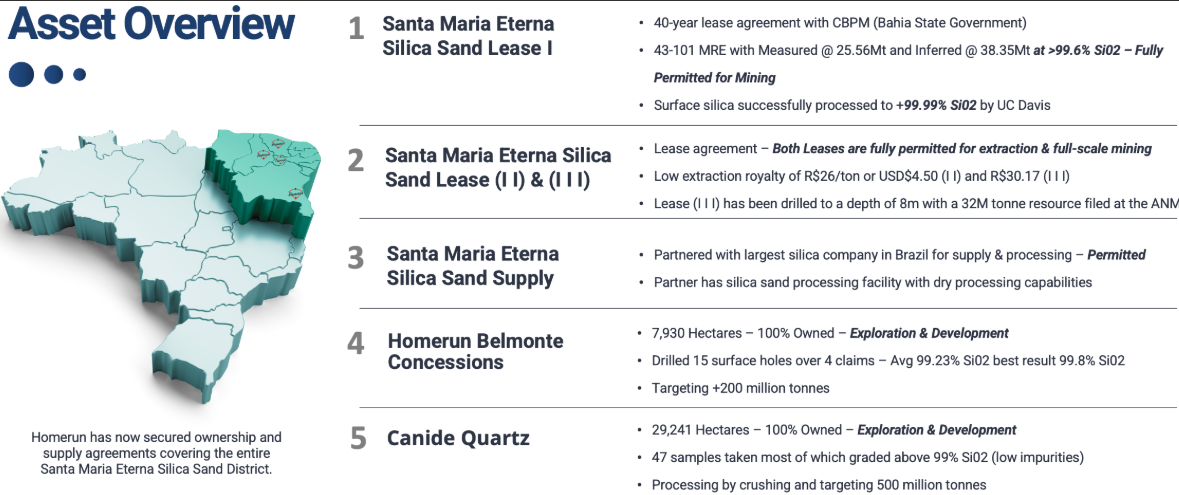
HMR controls a district-scale land package in Belmonte
Brazil is the third-largest producer of silicon, after China and Russia, and hosts one of the world’s largest quartz reserves. A key advantage of HMR’s projects is their potential for HPQ silica, with minimal impurities. By simply washing raw silica sand, purity levels of 99.96% have been achieved. These results have been independently verified by the German testing firm Dorfner Anzaplan.
Third-party verified HPQ for Advanced Applications
Further third-party testing by Minerali Industriali Engineering (MIE) confirmed that the sand is suitable for producing antimony-free solar glass. Antimony, a chemical traditionally used in glassmaking, is increasingly being avoided by manufacturers for environmental and performance reasons, giving HMR’s HPQ silica a competitive advantage in this market.
Santa Maria Eterna Silica Sand Lease I is HMR’s flagship and most advanced project, having already secured both environmental and mining permits.
Gained control of the flagship project, via a 40-year exclusive lease with CBPM (a government-owned entity in Bahia) for silica extraction
Location Map
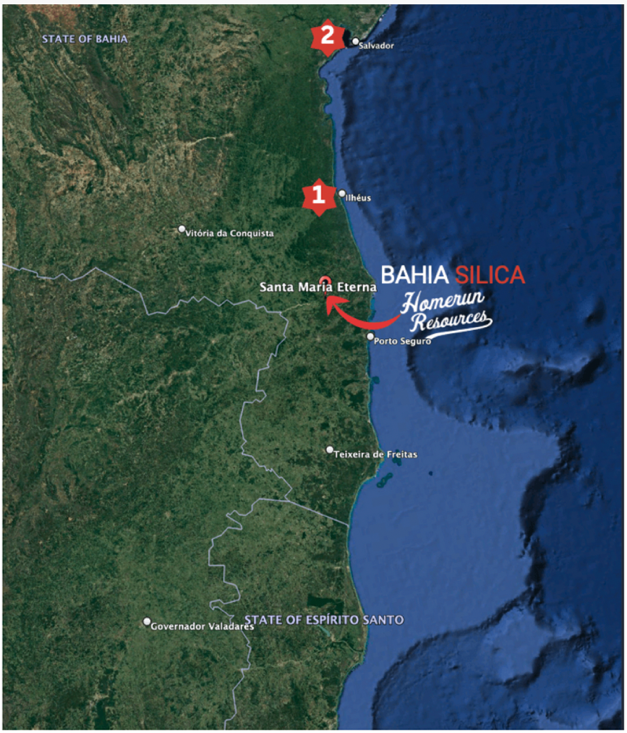
Located ~600 km from Salvador, Bahia’s capital
Strategic proximity to ports for domestic distribution, and global exports
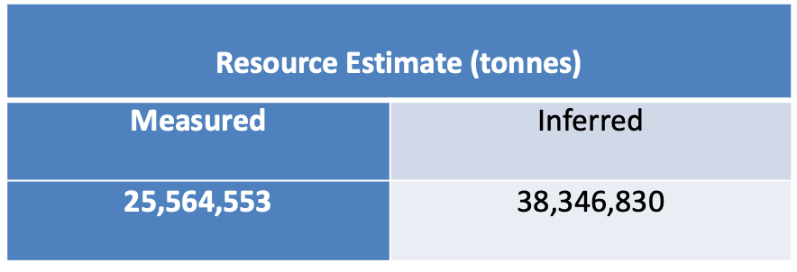
Medium-sized, open-pit resource
Source: Company
We believe there is significant resource expansion potential as the deposit remains open at depth
The company has a near-term path to revenue through a simple quarry operation involving excavation, screening, and washing. CAPEX is minimal, as HMR has partnered with a local operator under an MOU to manage the extraction, washing, and sorting of silica sand.
HMR recently secured a 12-month sales and distribution contract with Cristal Sand Group (a Brazil-based supplier of high-purity industrial sand for the luxury construction market), marking its first binding sales agreement . HMR also has a non-binding LOI with Jundu , a leading industrial silica producer in Brazil, for up to 365,000 tonnes per year of high-purity silica. Jundu will handle extraction and processing. Further details of the agreement were not disclosed.
First binding sales contract
Ultra-Pure Advanced Silica Materials
HMR is developing a 120 ktpa on-site silica sand processing plant to produce HPQ with >99.99% purity for high-value markets , such as semiconductors, optics, and advanced applications. Raw silica sand is first excavated, washed, and sized before entering the purification plant. Management’s preliminary CAPEX estimate is < $ 30 M , with the final figure to be confirmed by engineering contractors. Construction is expected to take six to 12 months.
Solar Glass Manufacturing
The global solar glass market is predominantly controlled by Asian producers, particularly China, from which Brazil imports a substantial share of its requirements. HMR aims to disrupt this import dependency by establishing Latin America’s first solar glass manufacturing facility in Brazil. Government policies, including a 25% tariff on imported Chinese solar components , and tax incentives for domestic production, create a favorable environment for the initiative. This aligns with Brazil’s expanding solar panel market , and its push for renewable energy self-sufficiency.
HPQ is a key raw material essential for solar panel production
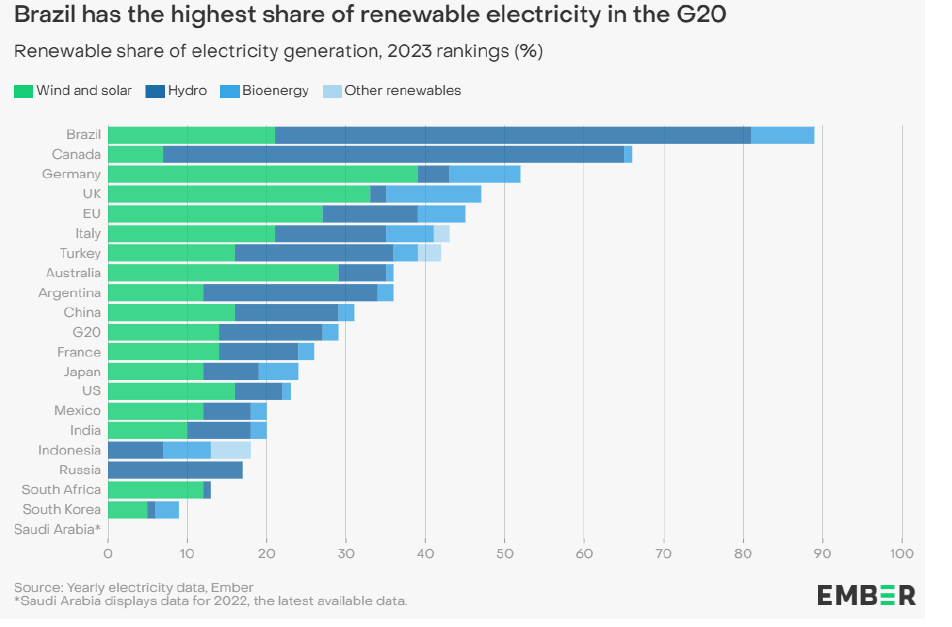
Brazil is a G20 leader in renewable electricity, with 89% of power from renewables
Solar accounts for 22% of installed capacity, second only to hydropower, providing a strong foundation for HMR’s planned solar glass plant
HMR Solar Glass Plant – Project Specifics
HMR to build Latin America's first solar glass plant
Completing a bankable feasibility study
Secures potential offtake agreements
We believe the upcoming feasibility study will clarify the project’s prospects, and path to execution.
Thermal Energy Storage and AI Energy Management System
Near-term development stages include prototype testing, design optimization, and economic feasibility assessment.
Collaborating with the U.S. Department of Energy’s NREL
Plan to scale to modular manufacturing within 36 months, pending successful demonstration
HMR is also developing a smart energy ecosystem that integrates hardware and software to efficiently store, manage, and optimize energy.
Financials
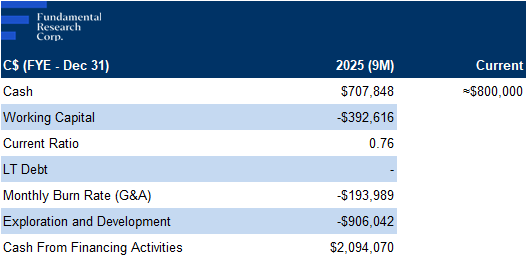
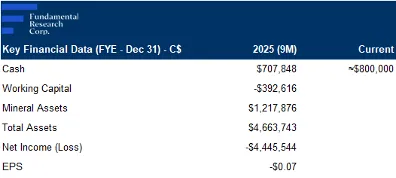
Healthy balance sheet
Subsequent to Q3, HMR secured a $6M equity commitment from an institutional investors (with funds to be released over 24 months),and closed a $1.57M equity financing
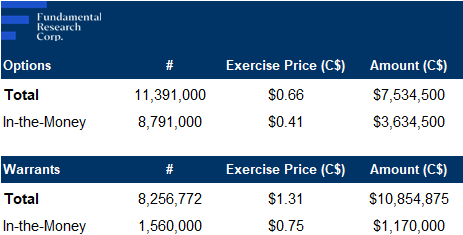
Can raise up to $4.80M from in-the-money options and warrants
Source: FRC / Company
FRC Valuation & Rating
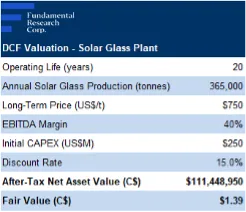
We continue to value HMR based on our discounted cash flow models on its two flagship initiatives: a) HPQ silica production from a potential 120 ktpa operation at the Santa Maria Eterna silica project, and b) the proposed 365 ktpa solar glass manufacturing plant. For conservatism, no value has been assigned to the company’s other initiatives.
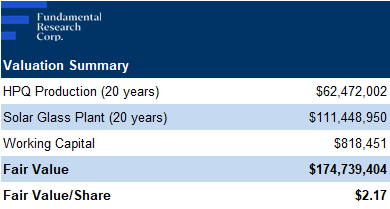
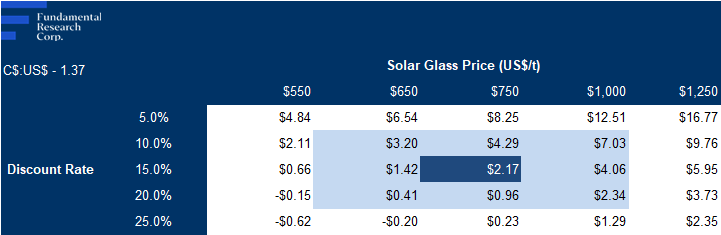
Using a sum-of-parts analysis, we estimate a fair value of $2.17/share (previously $2.54/share)
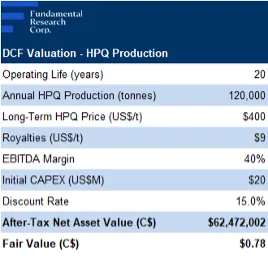
Valuation declined due to financing-related share dilution; all other assumptions remain largely unchanged
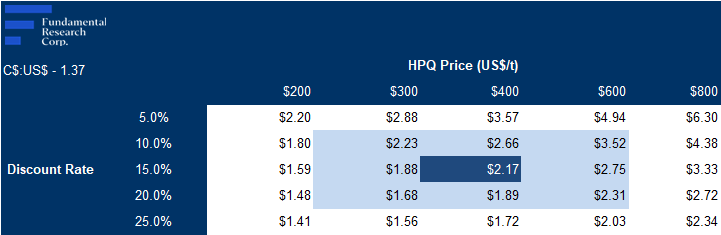
Our models remain highly sensitive to product prices
Source: FRC
We continue not to use comparable valuation models, as publicly traded silica juniors remain materially different from HMR. Most are pure explorers or developers without vertical integration, and many have higher impurity levels, making processing more capital-intensive.
We are reiterating our BUY rating, and revising our fair value estimate from $2.54 to $2.17/share. HMR is making measurable progress in building a fully integrated HPQ platform, differentiating itself from pure explorers through vertical integration, and near-term commercial traction. With its first binding sales agreement secured, government support, and a district-scale, NI 43-101 compliant resource, we believe the company is positioned to supply high -grade silica to strategic downstream markets.
Risks
We believe the company is exposed to the following risks (list is non-exhaustive):
We are maintaining our risk rating of 5 (Highly Speculative)


