
.webp&w=1920&q=75)
Disclosure: Builders Capital Mortgage Corp. has paid FRC a fee for research coverage and distribution of reports. See last page for other important disclosures, rating, and risk definitions.
The analyst’s rating and fair value are one click away. Free FRC account, no credit card.
Already have an account?
|
Key Financials (FYE - Dec 31) (C$) |
2023 |
2024(F) |
2025(F) |
|
Mortgage Receivables(net) |
$32,697,763 |
$35,112,698 |
$36,868,333 |
|
Revenues |
$4,675,142 |
$4,987,257 |
$4,714,758 |
|
Net Income |
$3,293,458 |
$3,686,503 |
$3,200,241 |
|
EPS |
$1.04 |
$1.17 |
$1.01 |
|
Dividends per Share (Class A) |
$0.80 |
$0.80 |
$0.80 |
|
Dividend Yield |
9.01% |
9.36% |
9.36% |
*See last page for important disclosures, rating and risk definitions. All figures in C$ unless otherwise specified.
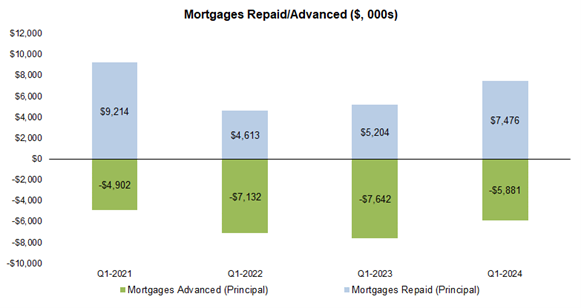
Mortgage advancements were down 23% YoY; repayments were up 44% YoY
As a result, mortgage receivables declined 4% QoQ to $31M; we are maintaining our year-end estimate at $35M
We will incorporate the impact of the ongoing bond financing into our models upon its completion
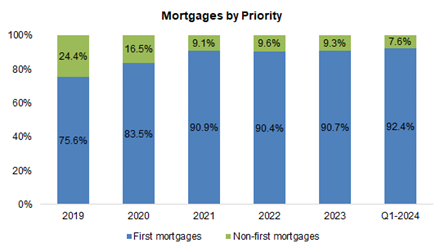
First mortgages increased, implying lower risk
 Source: FRC/Company
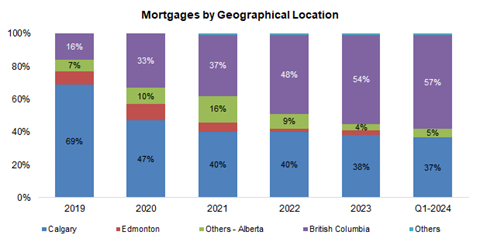
Increased exposure to B.C.
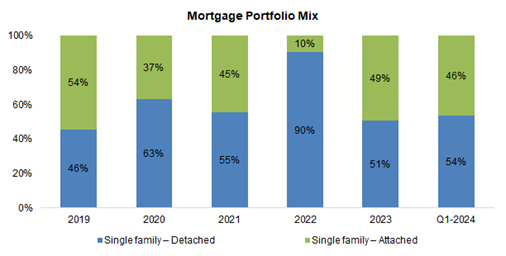
Remains focused on single-family units (construction)
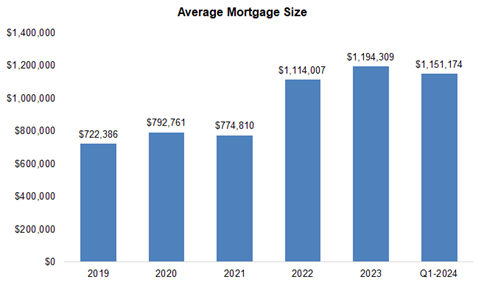
The average mortgage size was down 4% QoQ
Source: FRC/Company
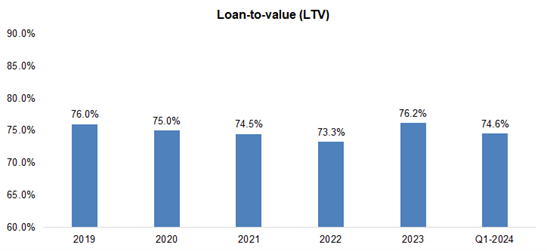
LTV was down 1.6 pp QoQ, implying lower risk

The average lending rate declined slightly, primarily due to higher first mortgages
 Source: FRC/Company
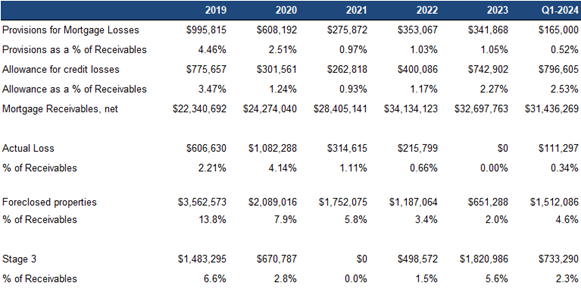
Foreclosed properties increased QoQ, from 2.0% to 4.6% of the portfolio
However, stage three mortgages (impaired) decreased QoQ, from 5.6% to 2.3% of mortgages
Management raised loan loss allowances by 0.27 pp QoQ to 2.53% of mortgages, aligning with our estimate
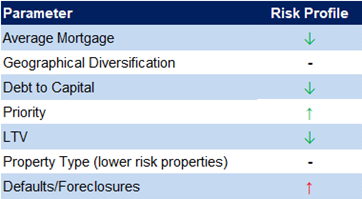
*Red (green) indicates an increase (decrease) in risk level.
Source: FRC
In summary, we believe the portfolio’s risk profile has decreased (one red vs four green signals)
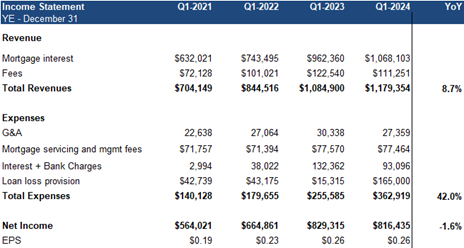
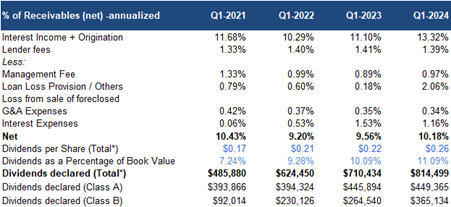
Revenue was up 9% YoY, beating our estimate by 4%, due to higher than expected lending rates
EPS was down 2% YoY due to higher loan loss provisions, but beat our estimate by 5%
Loan loss provisions were in line with our estimate
Source: FRC/Company
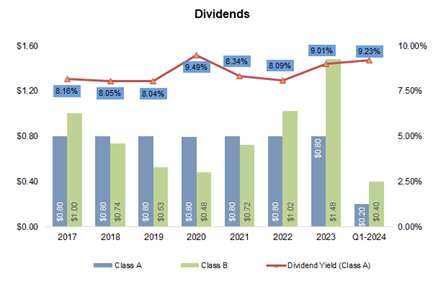
*Yields were calculated based on the average share price for the given time period. Note: Class A non-voting common shares are publicly listed, while Class B non-voting common shares are held by management and private investors. In terms of dividend distribution, Class A shares (public investors) rank first, followed by Class B shares. Class A shares will be paid $0.80 per share, before dividends are paid to Class B shares.
Dividends for Class A investors remained unchanged at $0.80/share, implying a yield of 9.4%
 Source: FRC Company
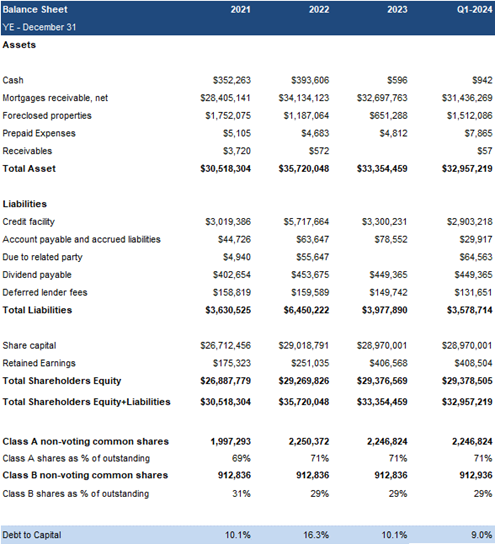
Debt/capital declined due to softer originations, and higher repayments
 Source: FRC
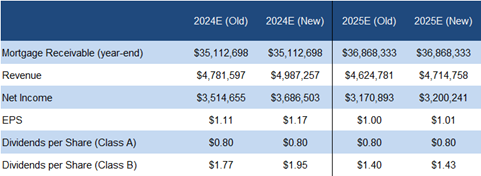
As interest rates have been higher than expected YTD, we are raising our 2024 EPS estimate by 5%
 Source: FRC
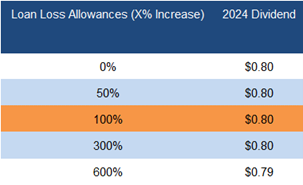
We note that the MIC should be able to distribute declared annual dividends ($0.80/share) even if loan loss allowances are raised by 500%
Source: S&P Capital IQ/FRC
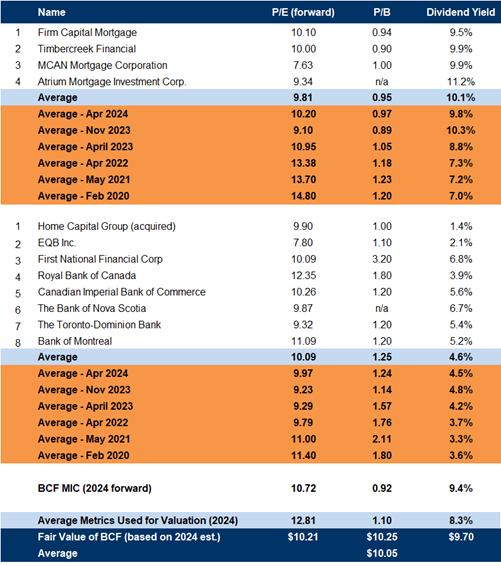
Sector multiples are down 3% since our previous report in April 2024, and 28% below pre-pandemic levels
Our fair value estimate decreased from $10.18 to $10.05/share, driven by lower sector multiples, partially offset by our higher 2024 EPS estimate
We are reiterating our BUY rating, and adjusting our fair value estimate from $10.18 to $10.05/share, implying an expected return of 27% (including dividends) in the next 12 months. Key risks include a softer mortgage origination market, and higher default rates. Anticipating lower interest rates, we foresee a potential rally in MIC/financial stocks in H2-2024. Although lower rates can compress profit margins, the resulting economic boost, and potential for higher valuations, will likely have a more significant positive impact.
The following, we believe, are the key risks of the company: