
Disclosure: HydroGraph Clean Power Inc. has paid FRC a fee for research coverage and distribution of reports. See last page for other important disclosures, rating, and risk definitions.
The analyst’s rating and fair value are one click away. Free FRC account, no credit card.
Already have an account?
China recently imposed restrictions on graphite exports. We believe this could lead to sourcing issues, and/or higher costs, for graphene maufacturers using graphite as a raw material. Hyperion does not use graphite to produce graphene, but relies on readily available gases (oxygen and acetylene) as inputs.
Since our previous report, HG has expanded its technology’s applications to mitigate Electromagnetic Interference (EMI). The company is collaborating with a manufacturer of electromagnetic shielding products. According to Report Linker, the global EMI shielding market will grow from US$6.6B in 2022, to US$8.6B by 2027, reflecting a CAGR of 5.4%.
HG is currently in discussions with 50+ potential customers, with 20+ actively testing their products.
Management is aiming to build 50+ units in the next three to five years, implying an annual capacity of 500 tonnes per year (tpy), or 4% of the global graphene market. The company anticipates securing initial sales orders in the second half of 2024.
HG has raised $1M of an ongoing $2M equity financing, with a substantial portion subscribed by a major UAE-based industrial gas company, and insiders.
Upcoming catalysts include initial sales orders, commercial production, and rising awareness of the benefits of graphene.
Company Overview
HydroGraph is one of only three companies in the world (and the only one in the Americas) certified by the Graphene Council as a Verified Graphene Producer.
Graphene Fundamentals
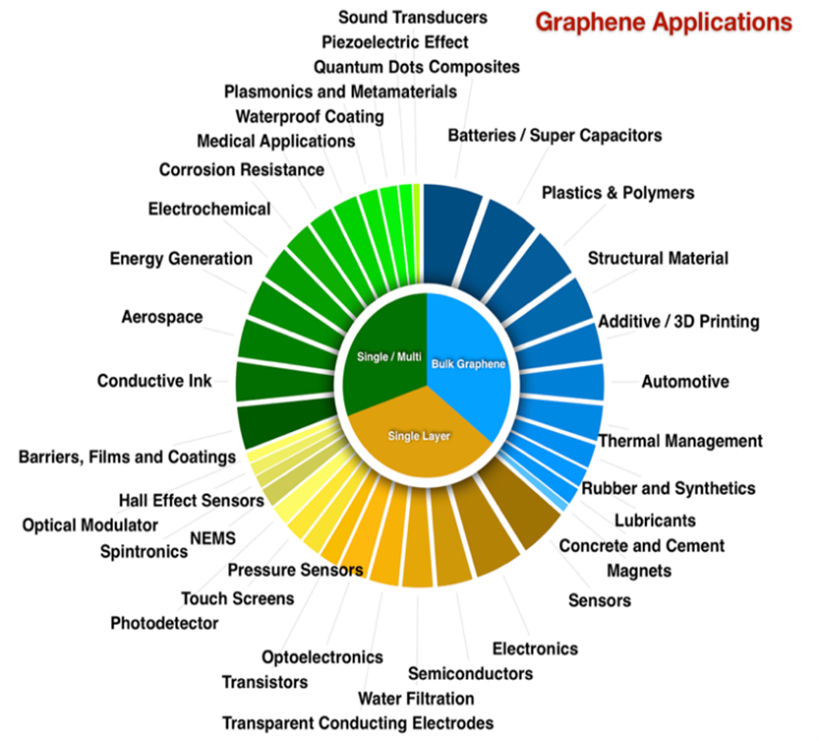
Source: Graphene Council
Graphene is 200x stronger than steel, harder than diamond, and 5x lighter than aluminum
Graphene can be added to a wide range of materials for improving strength, and lowering weight
Electronics account for 40% of demand
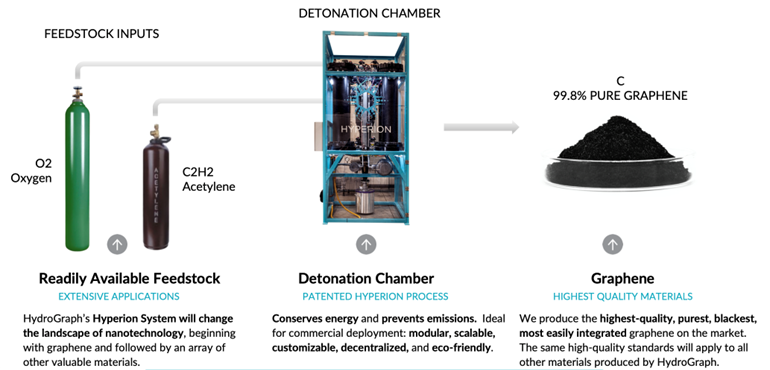
HG’s patented Hyperion system uses a detonation process to convert two readily available gases – oxygen and acetylene – into high-purity (99.8%) graphene.
Hyperion System Process
Source: Graphene Council
The Hyperion system is compact (2 m x 2m), and modular
Each unit can produce 10 tonned of graphene/year
Low environmental footprint, and low CAPEX ($150k-$250k/unit)
There are 300+ companies producing graphene globally, of various forms, grades, and purity.
Source:FRC
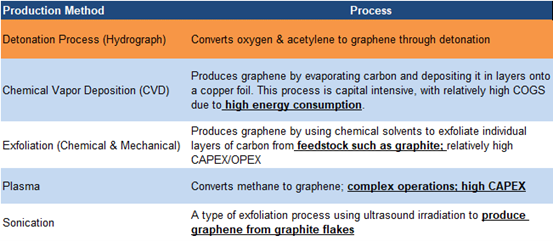
Existing manufacturing technologies are based on graphite exfoliation, or chemical processes
Key challenges of existing technologies include high CAPEX/COGS, high energy consumption, and inability to produce high-purity/quality graphene in large-scale
Comparison of GrapComparison of Graphene Production Methods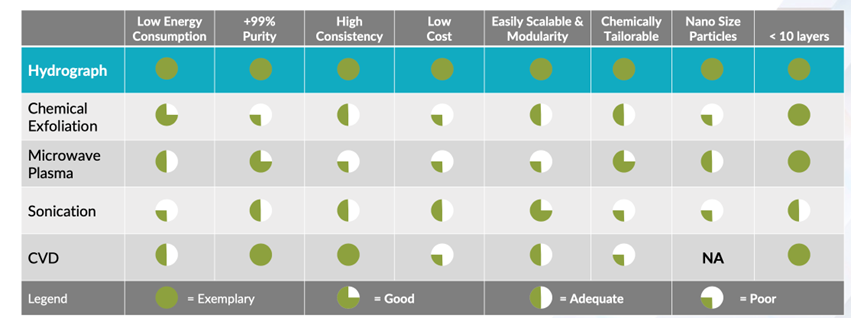
According to management, HG has significant advantages over its competitors
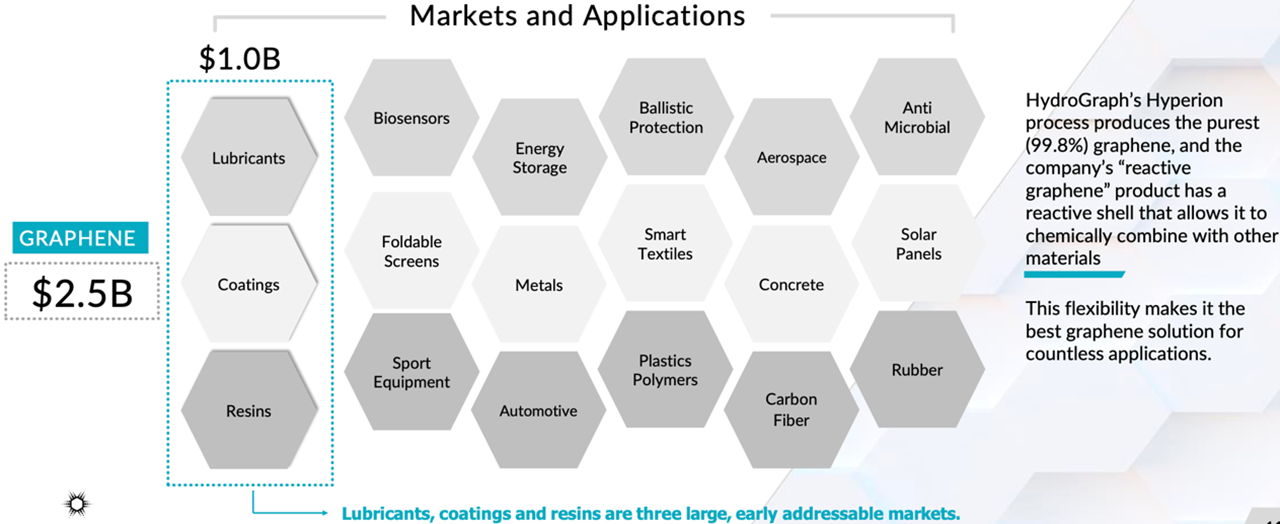
Source: Company
Management is initially targeting the lubricants / composites / resins market (used for machinery, aircraft, construction, and other applications), which is expected to account for 40% of global demand by 2028
Management is expecting initial sales orders in H2-2024
HG’s budget for the next 12-18 months is $8-$10M, allocated for marketing, tests, and working capital
Since our previous report, HG has announced the following material developments:
Promising test results – Internal tests have confirmed the effectiveness of HG’s graphene in electromagnetic interference (EMI) shielding, crucial for precision in GPS, medical, automotive, aerospace, and military applications. These tests also revealed increased electrical conductivity in HG’s graphene.
Commercial partnerships – HG has partnered with a manufacturer of electromagnetic shielding products to develop EMI coatings, and insulated barriers, using HG’s graphene.
Adding applications – Signed an agreement with an advanced materials supply chain company, and the University of Manchester Graphene Engineering Innovation Center, for developing multiple new applications for graphene.
Financials
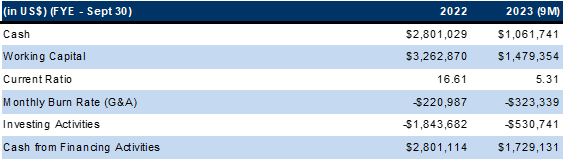
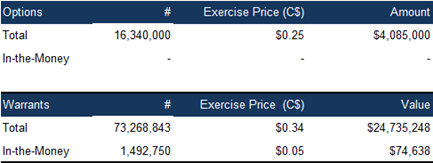
Source: FRC / Company
Healthy balance sheet
Subsequent to Q3, HG closed C$1M og a C$2M equity financing
Comparables
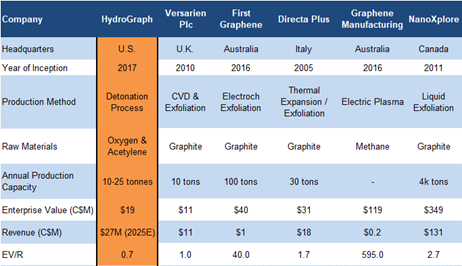
Source: FRC/Various/S&P Capital IQ
China is the top graphene producer, accounting for 60% of global supply
Most graphene companies rely on graphite, leaving them vulnerable to China’s recent restrictions on graphite exports
HG is trading at 0.7x our 2025 revenue forecast vs 2.7x for Quebec-based NanoXplore (TSX: GRA/MCAP: C$354M), one of the largest graphene producers outside China
DCF Valuation
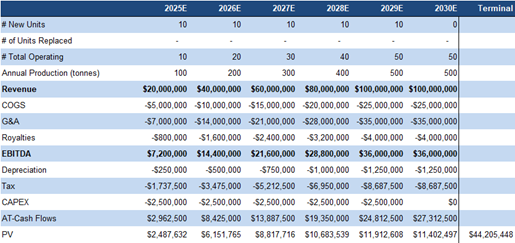
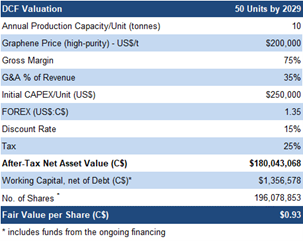
Source: FRC
Our DCF valuation decreased from C$1.04 to C$0.93/share due to share dilution from the ongoing financing
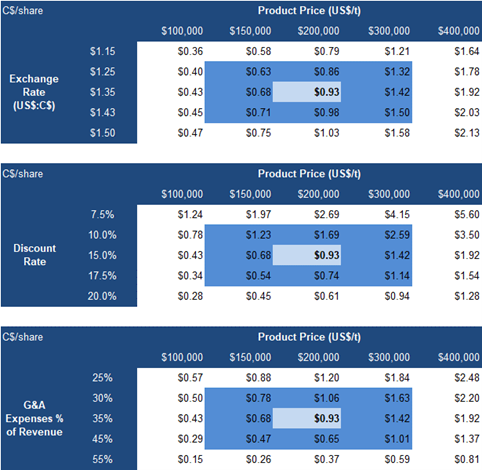
Source: FRC
Our valuation is highly sensitive to several key inputs
We are reiterating our BUY rating, and adjusting our fair value estimate from C$1.04 to C$0.93/share. We believe the emergence of new manufacturing processes, lower production costs, and rising awareness of the benefits of graphene, should drive long-term demand.
Risks
We believe the company is exposed to the following key risks (not exhaustive):
1. The company is in pre-revenue stage
2. The value of the company is dependent on graphene prices
3. No guarantee that its products will gain traction
4. Require approvals from the Environmental Protection Agency
5. Although HG’s technology is patented in the U.S., we believe patent infringement risks exist from international players